Site index
Created by:

The protocols that are outlined in this
document must be carefully reviewed before making the decision to adopt the
SOPs.
2.1.2
Organizations Adopting all SOPs
2.1.2.1 Organizations that
adopt all SOPs that are relevant to their operations will be given approval for
all analytical methods or sampling capabilities that are consistent with the
submitted equipment and instrumentation lists.
2.1.2.2 Determination of
approval status will occur within one month of submission.
2.1.2.3 Note that approval MAY NOT include all capabilities (i.e. analytical methods or
sampling protocols) that are listed in the CompQAP. Approval will be contingent on the use of
approved
analytical methods (see 2.3.3.4.b), adoption of all appropriate SOPs, and use of
appropriate equipment and/or instrumentation.
2.1.3
Organizations Adopting Portions of the SOPs
2.1.3.1 An organization that
does not wish to adopt all SOPs pertinent to their operations must submit a full
Comprehensive Quality Assurance Plan specified by DER-QA-001/90, however, the
selected SOPs may be incorporated by reference.
2.1.3.2 Organizations that
adopt all pertinent sample collection protocols may be given limited approval
pending status subject to the requirements specified in 2.1.2 above.
A Statement of Intent is required when adopting all or portions of the
protocols listed in this document.
1.
The Statement is a two-part document which must be completed and signed
by the appropriate parties.
2.
The Statement MUST BE SUBMITTED WITH SUPPORTING INFORMATION.
If adopting all SOPs, the organization must submit tables which include
lists of personnel, methods and equipment (Section 2.3).
If adopting some of the SOPs, the organization
must
submit a CompQAP with the Statement (Section 2.4).
3.
The document WITH ORIGINAL SIGNATURES must be submitted with all other
required information; it will not be
accepted if submitted without supporting documentation (see 2.3 and 2.4) or
if a copy of facsimile is submitted.
4.
This document may be obtained from the a DER District Office or by
writing to the Florida Department of Environmental Regulation, DER Library, 2600
Blair Stone Road, Tallahassee, Florida 32399-2400.
5.
This document shall not be retyped or modified.
A Statement of Intent that has been retyped by the organization WILL NOT
BE ACCEPTED.
2.2.1.1
The first part is a list of all SOP activities and protocols.
Complete this portion by:
a.
Filling in the name and address of the organization and the CompQAP
number (if already assigned);
b.
Placing an "X" or checkmark by each of the SOPs that your
organization intends to adopt. If
the organization does not have the capability, personnel or equipment to perform
certain tasks (i.e. hazardous waste sample collection, wastewater sample
collection, etc.), DO NOT check the associated SOPs.
2.2.1.2
Mandatory SOPs that must be Adopted
a.
If an organization intends to follow only adopted SOPs, Table 2.1
identifies the document chapters and/or sections that must be adopted and
checked on the Statement of Intent.
b.
Organizations that adopt portions of the SOPs must indicate those that
are to be adopted. NOTE:
THE INFORMATION THAT IS NOT ADOPTED BY SOPs MUST BE DISCUSSED IN THE TEXT
OF THE CompQAP (see Section 2.4).
2.2.1.3
Before determining the status of your QA Plan, this part of the statement
will be checked for inconsistencies and/or omission of pertinent SOPs as well as
correlation between the SOPs and the submitted equipment and instrument lists.
2.2.2.1
The second part of this document is a certification.
This portion certifies that the organization:
a.
Has obtained copies of all documents specified by the SOPs;
b.
Intends to follow all SOPs noted in Part I;
c.
Has the equipment and capability to perform the protocols specified by
Part I; and
d.
Is committed to generating data of a known and verifiable quality.
2.2.2.2
The Statement of Intent must be signed by at least two individuals:
a.
An individual who will be ultimately responsible for the quality, and
reliability of all data generated by the organization (usually the laboratory
manager, director of field operations, etc.); and
b.
The Quality Assurance Officer(s) of the organization.
2.2.2.3
The Statement must be properly dated and signed.
TABLE
2.1
MANDATORY
SOP CHAPTERS TO BE ADOPTED
|
CHAPTER/SECTION TITLE |
LABORATORY
ONLY |
FIELD (SAMPLE COLLECTION ACTIVITIES) |
FULL SERVICE FIELD &
LAB |
| CHAPTER 3 - ORGANIZATION AND RESPONSIBILITY | X | X | X |
| CHAPTER 4 - SAMPLING PROCEDURES |
|
|
Section 4.0
- General |
|
||||||||
|
|
Section 4.1
- Equipment
Decontamination |
|
||||||||
|
|
Section 4.1.1 |
General Concerns |
X |
X |
||||||
|
|
Section 4.1.2 |
Reagents |
X |
X |
||||||
|
|
Section 4.1.3 |
General Decontamination
Protocols |
X |
X |
||||||
|
|
Section 4.1.4 |
Sampling Equipment |
X |
X |
||||||
|
|
Section 4.1.5 |
Wastewater Automatic
Samplers |
||||||||
|
|
Section 4.1.6 |
Field Filtration Equipment |
||||||||
|
|
Section 4.1.7.1 |
Teflon Tubing |
||||||||
|
|
Section 4.1.7.2 - 5 |
Non-Teflon Tubing |
||||||||
|
|
Section 4.1.8 |
Pumps used for Purging
and/or Sampling |
||||||||
|
|
Section 4.1.9 |
Field Meters, Flow Meters,
and |
|
|
|
|||||
|
|
|
other Field Instruments |
||||||||
|
|
Section 4.1.9 |
Non-Sampling Equipment |
||||||||
|
|
Section 4.1.10 |
Analyte-Free Water
Containers |
||||||||
|
|
Section 4.1.11 |
Ice Chests and Shipping
Containers |
||||||||
|
Section 4.2
- Aqueous Sampling
Procedures |
|
|||||
|
|
Section 4.2.1 |
General Sampling Concerns |
|
|||
|
|
Section 4.2.2 |
Specific Sample Handling
Procedures |
|
|||
|
|
Section 4.2.3 |
Surface Water |
|
|||
|
|
Section 4.2.4 |
Wastewater |
|
|||
|
|
Section 4.2.5 |
Groundwater |
|
|||
|
|
Section 4.2.6 |
Wells with In-Place
Plumbing |
|
|||
|
|
Section 4.2.7 |
Potable Wells Sampling |
|
|||
|
|
Section 4.2.8 |
Drinking Water Supply
Systems |
|
|||
|
|
Section 4.2.9 |
Temporary Well Points |
|
|||
|
|
Section 4.2.10 |
Air Stripper and Remedial
Treatment Systems |
|
|||
|
|
Section 4.2.11 |
Bioassay |
|
|||
|
Section 4.3
- Solid Matrix
Sampling Procedures |
||||||
|
|
Section 4.3.1 |
General Sampling Concerns |
|
|||
|
|
Section 4.3.2 |
Specific Sample Handling
Protocols after Sample Acquisition |
|
|||
|
|
Section 4.3.3 |
Composite Soil Samples |
|
|||
|
|
Section 4.3.4 |
Soil Sampling |
|
|||
|
|
Section 4.3.5 |
Sediment Sampling |
|
|||
|
|
Section 4.3.6 |
Fish Tissue Sampling |
|
|||
|
|
Section 4.3.7 |
Shellfish Sampling |
|
|||
|
|
Section 4.3.8 |
Domestic Wastewater
Residual Sampling |
|
|||
|
|
Section 4.3.9 |
Hazardous Waste Sampling |
|
|||
|
|
Section 4.3.10 |
Macrobenthic Invertebrates |
|
|||
|
Section 4.4
- Sample Handling |
||||||
|
|
Section 4.4.1 |
Sample Container Cleaning |
X |
X |
||
|
|
Section 4.4.2 |
Sample preservation,
container types |
|
|
|
|
|
|
|
and holding times |
X |
X |
X |
|
|
|
Sources of preservation |
|
||||
|
|
Section 4.4.3 |
Sample Dispatch |
|
X |
X |
|
|
|
Section 4.4.4 |
Field Reagent Handling |
|
X |
X |
|
|
|
Section 4.4.5 |
Field Waste Disposal |
|
X |
X |
|
|
CHAPTER 5
- SAMPLE CUSTODY AND
DOCUMENTATION |
|
|
|
||||||
|
|
Section 5.1 |
General Requirements for
Custody and |
|
|
|
|
|||
|
|
|
Documentation |
X |
X |
X |
|
|||
|
|
Section 5.2 |
Preparation of Field
Sampling Supplies |
|
|
|
|
|||
|
|
|
and Equipment |
X |
X |
|
||||
|
|
Section 5.3 |
Custody and Documentation
Requirements for |
|
|
|
|
|||
|
|
|
Field Operations |
|
X |
X |
|
|||
|
|
Section 5.4 |
Custody and Documentation
Requirements for |
|
|
|
|
|||
|
|
|
Laboratory Operations |
X |
|
X |
|
|||
|
|
Section 5.5 |
Electronic Data
Documentation |
|
||||||
|
|
Section 5.6 |
Legal or Evidentiary
Custody Procedures |
|
||||||
|
CHAPTER 6
- ANALYTICAL
PROCEDURES |
|
|
|
|
CHAPTER 7
- CALIBRATION
PROCEDURES AND FREQUENCY |
|
|
|
|||||
|
|
Section 7.1 |
Introduction |
X |
X |
X |
|
||
|
|
Section 7.2 |
General Considerations |
X |
X |
X |
|
||
|
|
Section 7.3 |
Standard Receipt and
Traceability |
X |
X |
X |
|
||
|
|
Section 7.4 |
Frequency of Standard
Preparation and |
|
|
|
|
||
|
|
|
Standard Storage |
X |
X |
X |
|
||
|
|
Section 7.5 |
Minimum Calibration
Requirements for |
|
|
|
|
||
|
|
|
Field Instruments |
|
X |
X |
|
||
|
|
Section 7.6 |
Laboratory Instruments |
X |
|
X |
|
||
|
|
Section 7.7 |
Support Equipment
Calibration |
X |
|
X |
|
||
|
|
Section 7.8 |
Calibration Documentation |
X |
X |
X |
|
||
|
|
Section 7.9 |
Definitions |
X |
X |
X |
|
||
|
CHAPTER 8
- PREVENTATIVE
MAINTENANCE |
X |
X |
X |
|
CHAPTER 9
- MINIMUM QC
REQUIREMENTS AND ROUTINES TO CALCULATE AND |
|||||
|
ASSESS PRECISION, ACCURACY AND METHOD
DETECTION LIMITS |
|||||
|
|
Section 9.1.1 |
Minimum Field Quality
Control Requirements |
|
X |
X |
|
|
Section 9.1.2 |
Minimum Laboratory Quality
Control Requirements |
X |
|
X |
|
|
Section 9.2 |
Routine Methods used to
Assess Precision |
|
|
|
|
|
|
and Accuracy |
X |
|
X |
|
|
Section 9.3 |
Method Detection Limits
and Practical |
|
|
|
|
|
|
Quantitation Limits |
X |
|
X |
|
|
Section 9.4 |
Documentation |
X |
X |
X |
|
CHAPTER 10
- DATA REDUCTION,
VALIDATION AND REPORTING |
X |
X |
X |
|
CHAPTER 11
- CORRECTIVE ACTION |
X |
X |
X |
|
CHAPTER 12
- PERFORMANCE AND
SYSTEM AUDITS |
X |
X |
X |
|
CHAPTER 13
- QUALITY ASSURANCE
REPORTS |
X |
X |
X |
X - Section must
be adopted, subject to the following comments:
(1) Laboratories providing equipment cleaning services must adopt
this section
(2) Adopt only those protocols for which equipment is provided
(laboratories) and/or listed (field and full service)
(3) Mandatory if protocols discussed in the subsection are
adopted
(4) Adopt only if applicable
(5) Laboratories providing sample containers must adopt this
section
(6) The manner in which preservatives are provided/obtained must
be specified
2.3
COMPQAP FORMAT WHEN ALL SOPS ARE ADOPTED
Organizations adopting the SOPs that are pertinent to their operations
are required to submit the following information:
2.3.1
Laboratory or Full Service Organization
1. Statement
of Intent;
2. Names
of the key personnel within the organization;
3. Table
of Method numbers, matrix identification and QA Objectives for Precision and
Accuracy;
4. List
of all analytical instrumentation and support equipment.
5. List
of sampling capabilities (if applicable); and
6. List
of sampling equipment (if applicable).
2.3.2
Sample Collection (Field Activities)
1. Statement
of Intent;
2. Names
of the key personnel within the organization;
3. Table
of Method numbers for field measurements;
4. List
of sampling capabilities; and
5. List
of sampling equipment.
2.3.3
Submission Format and Requirements
2.3.3.1
General Requirements
a.
All Comprehensive QA Plans shall be submitted to the QA section in 3-ring
loose leaf binders. This allows the
QA section and the consultant to easily update or amend specific pages or
sections by removing outdated sections and inserting the new revisions.
b.
All plans must be submitted as final plans.
Draft documents or documents identified as draft will be returned
unreviewed.
c.
Incomplete plans or plans that do not conform to the formats specified in
this document shall be returned unreviewed.
d.
Only one (1) copy of the plan must be submitted to the DER QA Section.
Note: DER program managers
may request additional copies of the approved QA Plan for their records,
however, only one plan should be submitted to the QA section.
e.
The QA Plan must be submitted in numbered sections which correspond to
the list of topics outlined in Section 2.3.1 or 2.3.2 above. All sections (except the Statement of Intent) must be
identified with a document control header which shall be placed in the upper
corner opposite the binding of each document page with the following
information:
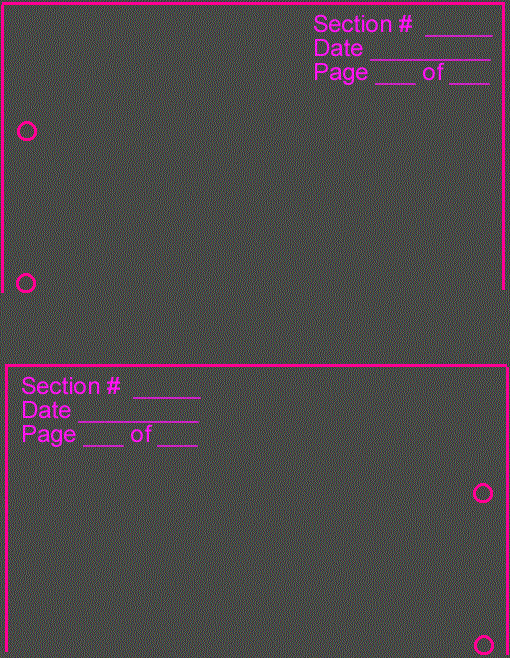
1. Section
No. - identifies the Section/Element
2. Date
- is the date of the revision
3. Page
of
- identifies the specific page within in the section, and the
total number of pages in the section (see Fig. 2.1).
NOTE: SECTIONS
ARE TO BE NUMBERED ACCORDING TO TITLES IN SECTIONS 2.3.3.3 THROUGH 2.3.3.6 OF
THIS DOCUMENT.
2.3.3.2
Statement of Intent - Complete per instructions in Section 2.2 above.
2.3.3.3
Section 1.0 - Key Personnel
a.
Provide a list of the salaried employees with title.
b.
The list should include KEY
PERSONNEL, only. Key personnel
are defined as: all individuals
from the owner/director/manager through line supervisors.
c.
Provide a list of branch offices (including address and phone number) IF
this CompQAP is to be used by more than one office.
Key personnel (with title) for each office shall be identified
2.3.3.4
Section 2.0 - Organization Abilities (Methods, Matrices, QA Targets and
Sampling Capabilities)
This section must outline the capabilities of the organization in terms
of analytical or testing methods (this section) AND,
IF APPLICABLE, sampling capabilities (Section 2.3.3.5).
All information shall be presented in table form.
The number of tables that will be required are dependent on the
capabilities of the organization and are outlined on Table 2.2.
The instructions in this section pertain to the
required tables for analytical and field measurement capabilities:
a.
General Requirements
1. This
section must include ALL field, biological and chemical analytical (measurement)
capabilities of a laboratory on consulting firm that are pertinent to DER
programs and rules. The components
in each method must be listed separately.
2. This
information must be presented in table form as described in Section 2.3.3.4.c
below.
3. The
analytical methods for field measurement parameters (pH, specific conductance,
temperature, etc.) must be presented as a separate table.
If equipment such as OVAs are used to screen
samples in the field, the method should not be listed in this section.
The equipment must be listed on the list of field equipment (Section
2.3.3.6.a)and pertinent calibration and preventative maintenance SOPs must be
checked on the Statement of Intent.
4. Precision,
Accuracy and Detection limits or goals must be provided for all parameters (EXCEPT
field measurements and screening methods).
If not available from in-house data, literature or method values may be
used but must be identified with appropriate annotations.
DER encourages generation of in-house QA objectives for all components
(unless otherwise specified by the method) and expects that this table will be
completed with in-house data no later than one year after final approval.
5. The
precision, accuracy and detection limits presented in the CompQAP shall be the routine
target values used by the consultant. Deviations
from these criteria must be addressed in quality assurance project plans.
b.
Approved Methods
1. All
analyses must be performed in accordance with currently accepted DER methods
(listed on Tables 2.3, 2.4 and 2.5).
2.
If there is no DER approved method for a specified component, the
following alternatives may be used:
a.
DER will review proposed existing methods other than those listed in
Tables 2.3, 2.4 and 2.5 and approve the use of the method, if appropriate.
Sources of such methods may be (see references in Appendix B for specific
revision dates):
1.
Standard Methods
2.
ASTM - American Society for Testing Materials
3.
USGS - U.S. Geological Survey
4.
AOAC - Methods of Analysis of the Association of Official Analytical
Chemists
.
Figure 2.1 DOCUMENT CONTROL HEADER PLACEMENT
Table
2.2
|
Table
Identification |
Laboratory |
Field |
Full-Service |
|
|
|
|
|
|
Analytical
Test Methods |
X |
|
X |
|
Sample
Preparation Methods * |
X |
|
X |
|
Field
Measurements |
|
X |
X |
|
Sampling
Capabilities |
|
X |
X |
* Required only if SW 846 methods are proposed as analytical test methods.
Laboratory - Provides only analytical services
Field - Provides only sample collection services
Full-Service - Provides both sample collection and analytical services
Table
2.3
AND
BIOLOGICAL ANALYSES
DRINKING
WATER
These methods must be used when analyzing
potable waters for compliance with Chapters 17-550, 17-551, 17-555 and 17-560,
F.A.C. and/or for certification under the HRS Drinking Water Certification
program.
1)
40 CFR Part 141, National Primary Drinking Water Regulations, July 1,
1991 Edition, Code of Federal Regulations, Subpart C (Monitoring and Analytical
Requirements, sections
141.21
to 141.30) and Subpart I (Control of Lead and Copper, section 141.89).
2)
"Methods for the Determination of Organic Compounds in Drinking
Water," EPA 600/4-88-039, December 1988.
3)
Chapter 10D-41, sections 50 to 62, F.A.C., Amended 11-15-90, HRS
Laboratory Certification Rules (Drinking Water Analyses).
4)
"Methods for Chemical Analysis of Water and Wastes," EPA
600/4-79-020, revised March 1983.
5)
Standard Methods for the Examination of Water and Wastewater,
APHA-AWWA-WPCF, 17th Edition, 1989.
6)
"Manual for Certification of Laboratories Analyzing Drinking Water,
Criteria and Standards Quality Assurance" EPA 570/9-90-008, April 1990 as
updated by Change I (EPA
570/9-90-008A),
October 1991 and Change 2 (EPA-814B-92-002), September 1992.
7)
40 CFR Part 136, Guidelines Establishing Test Procedures for the Analysis
of Pollutants Under the Clean Water Act, July 1, 1991, Appendix A.
NOTES:
1)
"500" series methods shall be used only for regulatory analysis
of drinking water (see above statement) unless approved by DER for use in other
matrices or programs.
2) Only
Methods 502.1, 502.2, 503.1, 504, 505, 507, 508, 508A, 515.1, 524.1, 524.2 and
531.1 from Reference 2 and Methods 604, 606, 609, 612, 613 and 625 from
Reference 7 are approved for analysis of drinking water by state certified
laboratories.
SURFACE
WATER, GROUNDWATER, AND WASTEWATER (DOMESTIC/INDUSTRIAL) EFFLUENTS
1)
40 CFR Part 136, Guidelines Establishing Test Procedures for the Analysis
of Pollutants Under the Clean Water Act, Tables IA, IB, IC, ID, and IE, as
published in the Federal Register, Vol. 65, No. 165, pp. 50758-50770, October 8,
1991.
2)
Methods for Chemical Analysis of Water and Wastes, EPA 600/4-79-020,
revised March 1983.
3)
"Test Methods for Evaluating Solid Waste, Physical Chemical
Methods", Third Edition (EPA SW-846), 1986 as amended by Final Update 1,
November 1990.
4)
40 CFR Part 261, Identification and Listing of Hazardous Waste, July 1,
1991, Appendix III (Chemical Analysis Test Methods).
NOTES:
1)
Laboratories analyzing samples in support of NPDES Permits are limited to
methods specified in Reference 1 above or those specifically approved for use by
EPA.
2)
Only those methods in Reference 2 which are specified in Reference 1 are
approved.
Table
2.3, cont.
DER APPROVED
ANALYTICAL METHODS AND REFERENCES FOR WATER
AND
BIOLOGICAL ANALYSES
3) Methods
and protocols specified by References 3 and 4 above must be used when analyzing
samples in support of RCRA related activities.
Approved Methods to be used in support of DER Rules and Programs:
1)
Pesticides and Herbicides:
a.
"Methods for the Determination of Nonconventional Pesticides in
Municipal and Industrial Wastewater," EPA 821 RR-92-002, April 1992.
Note: methods in the
Appendix (EV-024 and EV-025) require method validation from the laboratory.
b.
N-Methyl Carboxylamines and N-Methyl Carbamates - EPA Method 531
(600/4-88-039). Approved ONLY for
the analysis of these components in groundwater samples.
2) Inorganics:**
a.
BROMINE - SM 408E, SM
4500-Cl-G - The approved method is for residual chlorine.
However, in the absence of chlorine, the DPD colorimetric procedure can
be adapted to measure bromine content of the sample.
In such case, the validity of this assumption must be verified by using
another procedure for chlorine which is not affected by the presence of bromine
(i.e. negligible interference).
b.
BROMATES - EPA 300.0 B -
"Determination of Inorganic Anions in Water by Ion Chromatography" by
Jack D. Pfaff, Carol A. Brockoff, and James W. O'Dell, U.S. EPA, Cincinnati,
Ohio, 45268.
c.
CHLOROPHYLLS - SM 1002G, SM
10200 H
d.
CORROSIVITY (CaCO3 Stability,
Langelier Index):
1)
SM 203, SM 2330
2)
ASTM D513-82
e.
EDB in groundwater:
1)
EPA 601 modified using an electron capture detector instead of an
electrolytic conductivity detector
2)
EPA 504
3)
HRS (Florida Department of Health and Rehabilitative Services) Method for
the analysis of EDB
4)
EPA 8011
f.
ODOR - SM 207, SM 2150
g.
SALINITY:
1)
SM 210A, SM 2520 B
2)
SM 210B, SM 2520 C
3)
SM 210C
h.
TASTE:
1)
SM 211 A, B, SM 2160 B, C, D
2)
ASTM 1292-86
i.
TOTAL DISSOLVED GASES - SM
2810
j.
TRANSPARENCY - 17-3.031(6),
F.A.C.
k.
UN-IONIZED AMMONIA - DER-SOP -
DER Central Analytical Laboratory, Tallahassee, FL, Revision No. 1, October 3,
1983. (Available from the DER QA
Section)
**
Methods coded SM XXX are from Standard Methods for the Examination of
Water and Wastewater, 16th Edition, 1983, those coded SM XXXX are from the 17th
Edition, 1989 (except Chlorophyll where SM 1002G is from the 16th Edition and SM
10200H is from the 17th Edition). Methods
coded ASTM are from the American Society for Testing Materials.
Table
2.3, cont.
DER
APPROVED ANALYTICAL METHODS AND REFERENCES FOR WATER
AND
BIOLOGICAL ANALYSES
BIOLOGICAL
Microbiological
1)
Drinking Water Analyses - 40
CFR Part 141, Subpart C (Monitoring and Analytical Requirements, section
141.21), July 1, 1991.
2)
Water and Wastewater Analyses
- 40 CFR Part 136, Table IA as published in the Federal Register, Vol. 65, No.
165, pp. 50758-50770, October 8, 1991. Table 2.3, cont.
3)
"Microbiological Methods for Monitoring the Environment" EPA
600/8-78-017, 1978.
4)
Standard Methods for the Examination of Water and Wastewater,
APHA-AWWA-WPCF, 17th Edition, 1989.
Bioassay
1)
"Methods for Measuring the Acute Toxicity of Effluents and Receiving
Waters to Freshwater and Marine Organisms (Fourth Edition)" EPA
600/4-90-027, September, 1991.
2)
"Short-Term Methods for Estimating the Chronic Toxicity of Effluents
and Receiving Waters to Freshwater Organisms (Third Edition)" EPA
600/4-91-002, 1991.
3)
"Short-Term Methods for Estimating the Chronic Toxicity of Effluents
and Receiving Waters to Marine and Estuarine Organisms (Second Edition)"
EPA 600/4-91/003, 1991.
Macrobenthic Identification and Enumeration
1)
"Macroinvertebrate Field and Laboratory Methods for Evaluating the
Biological Integrity of Surface Waters", ORD, Washington, D.C., November
1990
2) Standard
Methods for the Examination of Water and Wastewater, Part 10500, 17th Edition,
APHA, 1989.
Table
2.4
SEDIMENTS,
SOILS, RESIDUALS AND SOLID AND HAZARDOUS WASTES
SOILS
AND SEDIMENTS
1)
"Test Methods for Evaluating Solid Waste, Physical Chemical
Methods", Third Edition (EPA SW-846), 1986 as amended by Final Update 1,
November 1990.
2)
"Procedures for Handling and Chemical Analysis of Sediments and
Water Samples" EPA/Corps of Engineers, EPA/CE-81-1, 1981.
3)
*"USEPA Contract Laboratory Program Statement of Work for Inorganic
Analysis", ILMO 2.0 (July 1990) and ILMO 2.1 (September 1991).
4)
*"USEPA Contract Laboratory Program Statement of Work for Organic
Analysis", ILMO 2.0 (July 1990) and ILMO 2.1 (September 1991).
5)
Estuarine Sample Preparation and
Analysis - Deepwater Ports Maintenance Dredging and Disposal Manual,
Department of Environmental Regulation, Coastal Zone Management, Revision 4,
December 1984.
DOMESTIC
AND INDUSTRIAL SLUDGES (RESIDUALS)
1)
"Test Methods for Evaluating Solid Waste, Physical Chemical
Methods", Third Edition (EPA SW-846), 1986 as amended by Final Update 1,
November 1990.
2)
"POTW Sludge Sampling and Analysis Guidance Document" USEPA
Permits Division, August 1989.
SOLID
AND HAZARDOUS WASTES
1)
"Test Methods for Evaluating Solid Waste, Physical Chemical
Methods", Third Edition (EPA SW-846), 1986 as amended by Final Update 1,
November 1990.
2)
40 CFR Part 261, Identification and Listing of Hazardous Waste, July 1,
1991, Appendix III (Chemical Analysis Test Methods).
3)
*"USEPA Contract Laboratory Program Statement of Work for Inorganic
Analysis", ILMO 2.0 (July 1990) and ILMO 2.1 (September 1991).
4)
*"USEPA Contract Laboratory Program Statement of Work for Organic
Analysis", ILMO 2.0 (July 1990) and ILMO 2.1 (September 1991).
* Methods
from these references shall be used and/or referenced by laboratories under
direct contract to EPA to perform analyses for Superfund (CERCLA) site
investigations.
Table
2.5
(INCLUDES
DRAFT AND MODIFIED METHODS)
SOLID
SAMPLES (Soils, Sediments, Sludges, Residuals, etc.):
1) Total
Recoverable Hydrocarbons (Petroleum) - SW 846 method 9073 (draft)*
2)
Total Halides:
a)
SW 846 method 5050/9056
b)
SW 846 method 5050/9252
c)
SW 846 method 5050/9253
*
Copy available from the DER QA Section
MODIFIED
METHODS:
EPA
Methods 300.0 (Revised August 1991) and 9056
- Method 300.0 may be used for the analysis of the METHOD SPECIFIED ions in
groundwater and surface water. Method 9056 may be used for the METHOD SPECIFIED
ion EXCEPT for fluoride.
EPA
Methods 601, 602, 624 and 625
- Capillary columns may be used instead of the specified packed columns if the
laboratory can meet the performance criteria (precision, accuracy and method
detection limits) of the method.
EPA
Methods 601 & 602
- The photoionization detector and electrolytic conductivity detector may be
used in series if the laboratory can meet the performance criteria of the
specified methods.
EPA
Methods 602, 8020, & 8021
- May include the analyses for xylenes and methyl tert-butyl ether (MTBE).
Note:
required for Chapter 17-770 work.
EPA
Method 610, 625, 8100, 8310, 8250 & 8270
- May include the analyses for 1-methylnaphthalene and 2-methylnaphthalene.
Note:
required for Chapter 17-770 work.
EPA
Method 5030/8010
- Must be modified to analyze for EDB in soils.
An electron capture detector instead of a electrolytic conductivity
detector must be used.
b.
If no appropriate method exists in any of the above-referenced documents,
a full method validation package (as outlined in Rule 17-160.520, F.A.C.) must
be submitted as an appendix to the CompQAP
3.
Modified or Alternative Methods
a.
Modified Methods - Any modification to approved analytical methods must
be identified in the table as "mod",
and details of the modification must be provided as an attachment even if the
modification has been approved by DER or EPA.
b.
Alternative methods - A laboratory who wishes to use an alternative
method that is not listed on Tables 2.3, 2.4 or 2.5 must list the method number
in the table, and added as an attached a method validation/equivalency package
that has been prepared per the instructions in Appendix E of DER-QA-001/90.
c.
If components which are not specified by the analytical method are
analyzed (e.g. malathion using method 608), a method validation package (see
Appendix E of DER-QA-001/90) must be submitted for review and approval, and must
be included as an appendix to the CompQAP.
ALL
METHODS THAT DO NOT HAVE EPA OR DER APPROVAL MUST BE REVIEWED AND APPROVED BY
DER BEFORE USING ON ANY DER-RELATED WORK.
c.
Methods Section Format - Laboratories must include a minimum of two
tables (sample preparation and analysis methods); three if sample collection
activities are included in capabilities. Field
QA Plans must include a table of analysis methods.
1.
Sample Preparation - Sample preparation method numbers must be presented
for any EPA SW 846 method that does not specify a sample preparation
(extraction, digestion, clean up, etc.) method.
These sample preparation methods shall identify the sample preparation
number and the appropriate methods to which the procedure applies (see Fig.
2.2).
Figure
2.2
Section
4.0
7-22-95
Page 5 of 135
Table
2.1
SAMPLE PREPARATION METHODS
|
Sample Prep. |
|
|
|
|
Method Number |
Description |
Matrix |
Sample Prep for these Methods: |
|
|
|
|
|
|
3005
|
Acid Digestion
|
Water |
6010, 7020. 7040, 7080, 7130 |
|
3020
|
Acid Digestion
|
Water, Soil |
7041, 7091, 7131 |
|
3015
|
Microwave Digestion |
Water |
6010 |
|
|
|
|
|
|
3510
|
Liquid/Liquid Extraction |
Water |
8081, 8141 |
|
3540
|
Soxhlet Extraction |
Soil |
8081, 8141 |
2.
Analytical methods - This table must include information concerning
analytes, method numbers, matrices and quality control criteria:
a.
Method Number
1.
Method numbers must be provided for each proposed matrix and component.
2.
List all equivalent methods (i.e. SW 846 and "600" series
methods) if seeking approval to perform analyses by both methods.
b.
Matrix Identification - Since precision and accuracy objectives are
matrix specific, each method must identify the matrices to be analyzed.
Identify the matrix groups as follows:
1.
Drinking water
2.
Water - Includes surface water, groundwater and wastewater (these may be
identified separately)
3.
Saline waters
4.
Soils and sediments
5.
Chemical wastes (includes sludges and residuals from domestic or
industrial wastewater processing)
6.
Biological tissues (includes shellfish, fish and mammalian)
c.
Component Name - All components (compounds or chemicals) that are to be
analyzed must be listed.
1.
If a primary method (ex. Method 608) has published addenda (ex.
Method 608.1 and Method 608.2) and if the components in the addenda are
to be analyzed, these analytes may be included under the same method number
heading.
2. Use component names as they are listed in the method.
d.
Precision Targets
1.
Must be described by the maximum allowable variance and reported as the
upper acceptable value (e.g. 5%). The
specific units (i.e. % RSD, RPD, I) shall be identified and calculated according
to the formulas specified in Chapter 9 of this document.
NOTE: RPD AND THE INDUSTRIAL
STATISTIC WILL BE CONVERTED TO % RSD IN THE QA DATA BASE.
2.
All precision limits must be generated from in-house data.
If no data exists, published method values or internal goals may be used
until in-house values can be generated.
3. All
internal goals, literature or method reference data must be identified.
e.
Accuracy Targets
1.
Must be reported as a range (e.g. 90-125%) and calculated per
instructions in Chapter 9.
2.
Accuracy target values should be derived from historical in-house data.
If unavailable, method targets or internal goals may be used until
in-house values are available.
3.
All internal goals, literature or method targets must be properly
identified.
f.
Method Detection Limits (MDLs) or Practical Quantitation Limits (PQLs)
1.
The method detection limit or practical quantitation limit for each
component must be provided.
2.
Identify the reporting units (e.g. mg/kg, ug/L, etc.) and whether MDL or
PQL.
3.
Do not mix MDL and PQLs on the same tables.
Enter values for only one of the two types.
4.
Specify the method by which the MDLs were calculated (see Chapter 9):
EPA, IUPAC or USATHAMA.
a.
Note: Since PQLs are based
on the determination of MDLs, the method by which MDLs are calculated is
required EVEN IF PQLs are reported.
b.
The QA Data Base will convert all reported PQL values to MDLs using the
definition of PQL specified in Chapter 9. This
means that all PQL values will be divided by a factor of 4.
5.
Criteria or Action level goals may be listed in lieu of MDLs or PQLs if
these requirements are met:
a.
Criteria or action levels that must be met for a specified permit or
program exceed the minimum detection limit of the method by two orders of
magnitude (e.g. MDL is 2 ppb, the criteria or required reporting level is 200
ppb).
b.
These targets are identified by specific reference to Department Criteria
or permit requirements.
c.
The use of elevated targets is justified in this section.
g.
QA Target Concentration Ranges
1.
For each QA Target of precision and accuracy, identify the concentration
level that was used to determine the value.
The following codes and concentration definitions shall be used:
a.
L - low range is the lower 20% of the linear calibration range.
b.
M - mid range is defined as the concentrations from 20% to 80% in the
linear calibration range.
c.
H - high range is defined as the concentrations which are in the upper
80% of the linear calibration range.
h.
The following acronyms shall be used to prepare these tables:
1.
EPA refers
to methods found in any EPA approved source
2.
SM refers
to methods found in Standards Methods (specify edition)
3.
ASTM refers
to method references from ASTM
4.
USGS refers
to method references from the US Geological Survey documents
5.
AOAC refers
to method references from the Methods of Analysis of the Association of Official
Analytical Chemists
6.
NA
Not applicable
7.
MDL Method
Detection Limit
8.
PQL Practical
Quantitation Limit
9.
MOD Modified
Method
10.
DW Drinking
water
11.
SW Surface
water
12.
GW Groundwater
13.
SED Sediments
(includes domestic sludges)
14.
S
Soils
15.
EFF Effluent
16.
HW Hazardous
Wastes (includes chemical wastes and sludges)
17.
BIO Samples
from biological matrices (tissues, muscle, shellfish, etc.
18.
SA
Saline waters
d.
Examples of the required formats for laboratory and field parameters are
found in Figures 2.3 and 2.4.
Figure
2.3
EXAMPLE OF QA OBJECTIVES TABLE OF
LABORATORY MEASUREMENTS
Section 5
6-15-94
Page 6 of 30
TABLE
QRS
QUALITY
ASSURANCE OBJECTIVES
|
Method |
|
|
Prec. |
Conc. |
Accuracy |
Conc. |
MDL |
|
# |
Matrix |
Analyte/Component |
%RSD |
Range |
%R |
Range |
mg/kg |
|
|
|
|
|
|
|
|
|
|
EPA 8060 |
Sed |
Bis(2-ethylhexyl)phthalate |
30 |
L |
29-137 |
L |
670 |
|
|
|
Butyl benzyl phthalate |
30 |
L |
0-140 |
L |
330 |
|
|
|
D-n-butyl phthalate |
30 |
L |
8-111 |
L |
330 |
|
|
|
Diethyl phthalate |
30 |
L |
0-100 |
L |
330 |
|
|
|
Dimethyl phthalate |
30 |
L |
0-100 |
L |
330 |
|
|
|
Di-n-octyl phthalate |
30 |
L |
19-132 |
L |
330 |
|
|
|
|
|
|
|
|
|
|
EPA 8060 |
GW |
Bis(2-ethylhexyl)phthalate |
30 |
L |
54-80 |
L |
3 |
|
608 |
SW |
Butyl benzyl phthalate |
30 |
L |
68-108 |
L |
3 |
|
|
|
Di-n-butyl phthalate |
30 |
L |
78-114 |
L |
3 |
|
|
|
Diethyl phthalate |
30 |
L |
36-54 |
L |
3 |
|
|
|
Dimethylphthalate |
30 |
L |
54-90 |
L |
3 |
|
|
|
Di-n-octyl phthalate |
30 |
L |
66-84 |
L |
3 |
|
|
|
|
|
|
|
|
|
|
EPA 8080 |
GW |
Aldrin |
35 |
L |
58-100 |
L |
0.01 |
|
8081 |
SW |
"-BHC |
35 |
L |
59-100 |
L |
0.01 |
|
608 |
DW |
$-BHC |
35 |
L |
61-100 |
L |
0.01 |
|
608.1 |
EFF |
*-BHC |
35 |
L |
61-100 |
L |
0.01 |
|
608.2 |
|
(-BHC |
35 |
L |
60-100 |
L |
0.01 |
|
|
|
Chlordane |
35 |
L |
45-119 |
L |
0.2 |
|
|
|
p,p’-DDD |
35 |
L |
55-115 |
L |
0.02 |
|
|
|
p,p’-DDE |
35 |
L |
50-100 |
L |
0.02 |
|
|
|
p,p’-DDT |
35 |
L |
60-120 |
L |
0.05 |
|
|
|
Dieldrin |
35* |
L |
60-120* |
L |
0.02* |
|
|
|
Endosulfan I |
35* |
L |
60-120* |
L |
0.05* |
|
|
|
Endosulfan II |
35* |
L |
45-100* |
L |
0.01* |
|
|
|
Endosulfan sulfate |
35 |
L |
60-160 |
L |
0.05 |
|
|
|
Endrin |
35 |
L |
30-147 |
L |
0.01 |
|
|
|
Endrin aldehyde |
35 |
L |
30-100 |
L |
0.01 |
|
|
|
Heptachlor |
35 |
L |
60-110 |
L |
0.01 |
|
|
|
Methoxychlor |
35 |
L |
60-110 |
L |
0.2 |
|
|
|
PCNB^^ |
35 |
L |
50-100 |
L |
0.05 |
|
|
|
Toxaphene |
35 |
L |
41-126 |
L |
0.5 |
MDLs have been calculated based on the 40-CFR, Part 136
Method
* QA
Targets derived from literature values
^^ Additional
component - Method validation study attached as Appendix A
Figure 2.4 EXAMPLE OF METHODS TABLE FOR FIELD MEASUREMENTS
Section
5.0
8-17-90
Page 5 of 27
TABLE
XYZ
QUALITY ASSURANCE OBJECTIVES
Field Measurements
|
Method # |
Matrix |
Analyte/Component |
|
EPA 150.1 |
W |
pH |
|
EPA 170.1 |
W |
Temperature |
|
SM 2510 B |
W |
Specific Conductance |
|
EPA 360.1 |
W |
Dissolved Oxygen |
|
EPA 180.1 |
W |
Turbidity |
2.3.3.5 Section
2.0 - Organization Abilities - Sampling Capabilities
Organization that analyze samples must include
this list as an additional list in Section 2.0.
a.
Sampling capabilities must be listed in table form by major matrix groups
and major analyte groups. The
matrix groups shall be identified as: groundwater,
surface water, drinking water, wastewater, stormwater runoff, soils, sediments,
tissues, shellfish, domestic wastewater sludges, hazardous waste sludges, and
liquid hazardous wastes.
The major analyte groups are defined as
follows:
1.
VOCs - Volatile Organic Compounds to include Methods 601, 602, 624, 502.1
and 2, 503, 504, 524.1 and .2, 8010, 8020, 8021, 8240, 8260, EDB and purgeable
organic halides.
2.
Extractable Organics - To include base neutral components (e.g.
polynuclear aromatics), acid extractable components (e.g. phenols), pesticides,
herbicides, and PCBs.
3.
Metals - All metallic analytes
4.
Inorganic Anions - To include inorganic anions and other non-metallic
tests: bromide; bromine; chloride;
chlorine; iodide; nutrients (ammonia, Kjeldahl nitrogen, nitrate, nitrite,
phosphate, o-phosphate); sulfate; silica; sulfite; acidity; alkalinity;
dissolved oxygen and dissolved silica.
5.
Organics - To include biochemical oxygen demand, chemical oxygen demand,
oil and grease, total organic carbon, total recoverable petroleum hydrocarbons,
phenolics, and surfactants.
6. Physical Properties - To include color, specific conductance, hardness, odor, pH, all residues (filterable, non-filterable, total, volatile and settleable), temperature and turbidity.
7. Microbiology
- To include coliforms, streptococcus, enterococcus and other bacteria.
8.
Other - Tests that must be included are:
cyanide; biotoxicity; macroinvertebrate identification; and
radionuclides.
See
Figure 2.5 for the specified format.
2.3.3.6 Section
3.0 - Sampling Equipment and/or Analytical Instrumentation
On SEPARATE LISTS, list the laboratory and/or field equipment that is
used by the organization:
a.
Field Equipment
1.
The sampling equipment list must be limited to equipment that the
organization either owns or rents on a routine basis.
2.
The list must be presented in format specified in Fig. 2.6.
Note that construction materials of all purging and sampling equipment
(including tubing) must be specified.
3.
In addition to sample collection/purging equipment, the following must be
listed:
a.
All field measurement equipment (pH meters, conductivity meters, etc.)
and all field screening equipment (OVAs, GCs, etc.);
b.
All field decontamination equipment; and
c.
Miscellaneous and ancillary equipment (water level indicators, buckets,
gloves, etc.).
b.
Laboratory Analytical Instrumentation and Support Equipment
1.
The list of laboratory instrumentation must identify the type of
instrument. This list shall include
but is not limited to:
a.
Gas Chromatograph (detector types must be listed;
b.
Mass spectrometer (identify whether MS or ITD);
c.
ICP (specify whether sequential or simultaneous);
d.
HPLC (detector types must be listed;
e.
Types of spectrophotometers (UV-VIS, IR, etc.); and
f.
Atomic absorption spectrophotometers including all auxiliary atomic
absorption equipment (furnace, flame, hydride, cold vapor, etc.)
2.
Support Equipment should include:
a.
Analytical balances;
b.
Microscopes;
c.
TCLP and/or EP Toxicity equipment; and
d.
Ovens, refrigerators, water baths and incubators.
2.3.3.7 Submission
of CompQAP on Diskette
a.
All information listed above may be submitted on diskette as an ASCII
flat file. The specific format may
be obtained by writing or calling the QA Section or by accessing the information
through the QA Bulletin Board.
b.
A CompQAP that is submitted in this manner must be accompanied by a
signed and notarized hard copy of the Statement of Intent.
c. The initial screening review and determination of the QA Plan status will be performed when the information is uploaded into the QA data base. Additionally, the approved capabilities of your organization will be immediately accessible to DER Staff and the HRS Certification program.
EXAMPLE OF TABLE OF
SAMPLING CAPABILITIES
Section
6.0
6-27-96
Page 1 of 10
Table
6.5
SAMPLING CAPABILITIES
|
Parameter Group |
Sample Source |
|
|
|
|
Extractable Organics |
Drinking water, surface water,
groundwater, sediments, soils, hazardous waste sludge |
|
|
|
|
Volatile Organics |
Drinking water, surface water,
groundwater, sediments, soils, hazardous waste sludge |
|
|
|
|
Trace Metals |
Drinking water, surface water,
groundwater, sediments, soils, hazardous waste sludge |
|
|
|
|
Physical Properties |
Surface water, groundwater |
|
|
|
|
Inorganic Anions |
Surface water, groundwater |
|
|
|
|
Microbiology |
Drinking water, surface water,
groundwater, sediments, soils, domestic residuals |
EXAMPLE
OF FIELD EQUIPMENT TABLE
Section 6.1
12-17-97
Page 3 of 34
SAMPLING
EQUIPMENT USED BY QRS CONSULTANTS
|
Equipment |
Construction |
Use |
Parameter Groups |
|
Groundwater |
|
|
|
|
Submersible Turbine Pump |
SS Housing w/ PVC Tubing & Check Valve |
Purging required |
All; polishing |
|
|
|
Sampling |
Inorganic Anions, Metals |
|
|
|
|
|
|
|
SS Housing w/ Teflon Tubing & Check Valve |
Purging |
All |
|
|
|
Sampling |
All except VOCs |
|
|
|
|
|
|
Centrifugal Pump |
Teflon Tubing w/ Check valve |
Purging |
All |
|
|
|
|
|
|
Surface Water |
|
|
|
|
Sample Container |
Glass |
Grab Sample |
All except Si and F |
|
|
|
|
|
|
|
Plastic |
Grab Sample |
Inorganic Anions Metals, Microbiology |
|
|
|
|
|
|
DO Dunker |
Glass |
Grab Sample |
All |
|
Field Instruments |
|
|
|
Equipment |
Model & Mfg. |
Use |
|
pH Meter |
Acme 4000 |
Determine Well Stability, Field Measurement |
Miscellaneous Equipment
|
Equipment |
Construction |
Use |
Parameter Groups |
|
pH Standards |
|
|
|
|
4.0,
7.0 & 10 |
Original Container |
Calibration |
pH |
|
1+1 HCl |
Plastic Container |
Decontamination |
All |
|
1+1 Nitric |
Plastic Container |
Decontamination |
All except Nox |
|
Analyte Free Water |
Glass |
Decontamination Transport |
All |
|
|
Teflon Squeeze Bottle |
Decontamination Dispensing |
All |
2.4
COMPQAP FORMAT WHEN ADOPTING PORTIONS OF THE SOPS
The Comprehensive QA Plan must be submitted in the 15-element format
specified in the DER Manual for Preparing Quality Assurance Plans
(DER-QA-001/91, Revised 1992) and must contain all required information for
those sections or activities that ARE
NOT adopted by SOPs.
2.4.1
All topics specified by the DER Manual for Preparing Quality Assurance
Plans must be included in this document.
The subject matter may be by reference to adopted SOPs or must be fully
discussed in the QA Plan text.
2.4.2
A signed statement of intent (see Section 2.2 above) must be submitted
and will REPLACE the title page.
2.4.3
All activities or protocols from the SOP that are listed on the
statement of intent may be referred to by citation (see instruction below).
This means that the SOP information DOES
NOT NEED TO BE COPIED INTO TEXT OR ATTACHED AS AN APPENDIX.
2.4.3.1 A
BLANKET REFERENCE TO THE ENTIRE SOP DOCUMENT IS NOT ACCEPTABLE.
That is, you must specify the section or subsection that are pertinent
to your operations.
2.4.3.2
References to the POTW Sludge Sampling Document or the EPA Region IV
Standard Operating Procedures and Quality Assurance Manual must state the
protocol and specify the section, page number(s) and revision date.
Example:
"Waste sampling in pits, ponds and
lagoons will follow 4.12.3, pp. 3-5, revised February 1991."
2.4.3.3
References to the SOPs written by the QA Section must state the
protocol, the document title, section or subsection and revision date.
Examples:
"Sample Collection for Surface Water
Samples will be performed in accordance with the documents and references
specified in the DER Standard Operating Procedures for Laboratory Operations
and Sample Collection Activities, Section 4.2.1, revised 6-92."
"Sample containers will be obtained by option b in the DER
Standard Operating Procedures for Laboratory Operations and Sample Collection
Activities, Section 4.4.1, revised 6-92."
"Laboratory sample documentation will be organized
and maintained in accordance with the requirements specified in the DER
Standard Operating Procedures for Laboratory Operations and Sample Collection
Activities, Section 5.0, revised 6-92."